PhD content in brief

Internationalization of design research and education centers.
Promotion of international design networks
Valentina Auricchio

Today, small enterprises and artisans are facing a difficult moment in which they are not able to understand how to survive in a evermore competitive and global market. They no longer have contact with final users, which often live in other territories and belong to different cultures, and do not have the tools to connect and innovate at an international level.
Since the early 70’s, designers around the world have been working in this arena with the aim to help artisans reach new markets and learn how to develop autonomous innovative processes. Through transfer of knowledge and support in creating networks, designers have shown unique capabilities that can support internationalization processes of territories worldwide by:
_identifying new markets and interpreting cultures (EXPORT);
_identifying new technologies (CO-PRODUCTION);
_identifying new cultural context (CO-DESIGN).

In this scenario, design research and education institutions have had a fundamental role in engaging new research paths and developing education programs in the fields of design management and strategic design in order to support international competitiveness. The strive for internationalization has pushed design institutions to enlarge their networks, connect with territories and give students and staff the opportunity to widen their view. By doing so, they have become strategic entities for the internationalization of their countries.
In the knowledge based society, education and research institutions have become important actors in supporting the international competitiveness of their territories by developing innovative researches and forming new professional profiles.
Therefore, design research and education institutions have become gateways for companies interested in connecting and competing internationally.

The main aim of the research is to identify projects in which design institutions have supported the internationalization of productive territories in order to stimulate an international debate in this area.
The area of reference of the research is Social Design and it historically refers to those projects in which designers have had an important role in connecting the periphery with the center. Victor Papanek, Gui Bonsiepe and Victor Margolin have been the main design theorist in this area.
The research developed has aimed to collect projects that have been carried out in the past ten years in this field. Projects that have been developed by design centers, institutions, individual designers that demonstrate that design can have a strategic role in social and economical development. These projects are mainly lead by the desire to help artisans and small producers to reach new markets and to build connections with partners worldwide.
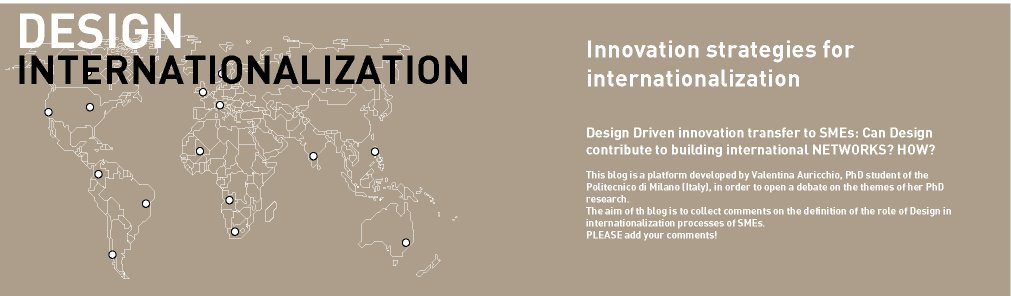
The research has been lead through on field research and interviews of actors involved in the debate and in the projects detected. The projects collected have been saved in an “online platform” (blog of the research www.innovstrategy.blogspot.com) which has been the a first interface with the research community.
Fifteen projects selected out of the many projects collected in the blog have been briefly explained through graphs and maps which give a general understanding of the state of the art in this field.

The analysis of the project has been done at different levels:
_geographical map of territories and actors involved;
_chronological map of the projects;
_role of the design actors in the projects;
_results respect to the internationalization of the territories involved;
_aims and objectives of the projects;
_project phases.

The final analysis of the projects aims to give a future view on the trajectories taken by the actors involved, the lessons learnt and the suggestions on how to take forward a debate in this field in order to develop new research and form professionals.
Today, there is a large amount of design centers, institutions and professionals who believe that design can have a strategic role in helping artisans and small companies in building global value chains. This belief has been demonstrated through real projects that show that designers are capable, not only in developing new products and services, but also in building global value chains that allow artisans to access new markets. Through these projects, designers transfer innovation capabilities to communities, enabling them to connect with partners worldwide.
However, this field is still not recognized as a research field in design and there are very few courses which aim to form professionals capable to replicate successful experiences in other contexts. This is also due to the fact that, up to today, design tools applied have not yet been codified.
Although the methods and tools identified in the projects still require confrontation and verification in other contexts, the catalogue of projects collected throughout the research is the first of its kind and the hope is for it to be a starting point for an international debate on design methods and tools applicable in this research area.

CASE STUDIES

The following list of posts are a collection of interesting articles which have been collected during the PhD research. Some of them are Design Centers, others are projects, others are links to websites.
Of these posts, 15 case studies have been picked out to be analysed in depth.

TO ADD PROJECTS OR LINKS PLEASE WRITE TO:
valentina.auricchio[at]polimi.it

Saturday, 24 November 2007

Innovation RCA


Innovation RCA is a new network set up by the Royal College of Art to link RCA graduates with business in order to create innovation opportunities.
Innovation RCA has been established with a major award from the UK Government's Higher Education Innovation Fund. It aims to bring greater coordination, clarity and reach to the Royal College of Art's relationship with business, and higher levels of professional support for new RCA graduates and alumni.
Innovation RCA's programmes in Applied Research, Product Development and Creative Business enable the College's graduates and business partners to work together to innovate more effectively.

Design Link


The Design Council runs “Design Link“ in each English region, These are committees of industrial designers who volunteer to be a support group for the Design Counsellors in that region’s Business Links. (Design Counsellors are specialist business advisers - who are meant t0 advise Business Link clients on design-related issues and to raise the importance of design as an integral part of business rather than as an after-thought, bolt-on). The idea is that Design Link members can open doors, suggest suitable contacts, help with further lines of inquiry etc.
http://www.cherry.gatech.edu/sim/refs/britain.pdf

IDBM


The International Design Business Management programme (IDBM) is a joint teaching and research programme of three leading Finnish universities: the Helsinki School of Economics, the University of Art and Design Helsinki and the Helsinki University of Technology. The purpose of the programme is to bring together experts in different fields within the concept of design business management.

The objective of the IDBM programme is to train skilled professionals for key roles in international design business. The programme emphasizes the importance of design as a competitive factor among others, such as technology. Arising from the needs of the industry, this programme gives future marketers, engineering experts and designers an opportunity to practice important interpersonal skills through projects and courses. The programme teaches students to make full use of their own potential as members of interdisciplinary teams.

Friday, 23 November 2007

DesignStart - GLOBAALI

Two SME SUPPORT PROGRAMS IN FINLAND:
The aim of the DesignStart-program is to strengthen the company’s competitiveness
through incorporation of such product characteristics perceived as important by
customers. DesignStart gives the company the possibility to use a professional designer,
either for products or to enhance the company image. The programme includes four
days of consultation over a period of three months.
see: http://217.152.18.69/page.asp?path=1866,1919,4330,7529,7530,11176,11183

DesignStart is an industrial design development programme targeted at both existing and new companies that are about to start their operation. The purpose of the programme is to assist the companies in developing the usability and outward appearance of their products or the graphical business image.Service branch companies can benefit from DesignStart in the development of their graphical business image, for example, in designing their logo and brochures, as well as, in commercialising their services.The programme is implemented as separate case-specific consultations between a DesignStart expert and the business management of a company. The programme is carried through in approximately a three-month period of time. The programmes are ordered from the DesignStart product managers at the TE Centres’ Business Departments.
The costs of DesignStart are:
420 € for companies younger than 3 years.
Additional consultation days (maximum 5 days) 165 € per day.
840 € for companies older than 3 years.
Additional consultation days (maximum 5 days) 300 € per day.

Globaali
Global – development programme for internationalisation (Business Department). The Global programme is tailored for SME’s that are about to start or already expanding their international activities to new market areas. The programme is particularly suitable for the time before applying for the internationalisation support.The target of the programme is to provide a company with a view on the opportunities and risks involved in its internationalisation, as well as, to investigate and evaluate the international operational prerequisites that the company has. The programme directs the companies to well-planned long-term internationalisation.
The cost of the Global programme is 630 € (with 2.5 consultation days).
Additional consultation (1-5 days) is available for 300 € per day.

Putting SMEs first


_SMEs – the lifeblood of Europe’s economy
_Think small first
_Facts & Figures
_Improving access to finance
_Facing environmental challenges together
_Ensuring fair competition
_Education and skills for entrepreneurship
_Helping SMEs go international
_Boosting research and innovation
_Protecting your ideas
_Micro- and craft enterprises in the EU
_Support for SMEs at regional level

EU policies and activities for Small and Medium-sized Enterprises


In the framework of the European Charter for Small Enterprises implementation process the Commission issued on 8 February 2005 several documents giving an overview of the most recent policies and initiatives in favour of small and medium-sized enterprises (SMEs) across Europe. Among these documents, the SME Envoy Report outlines European Union policies and activities in favour of SMEs.
Prepared under the coordination of the SME Envoy, the Report offers an overall presentation of the measures taken by the Commission for SMEs. It provides a review of policies, initiatives and programmes having an impact on SMEs covering not only the ten areas of the Charter for Small Enterprises but also other European Union policy areas relevant to SMEs.

Wednesday, 21 November 2007

GALLERIA NORSU


GALLERY NORSU is dedicated to Nordic contemporary craft. The gallery, in the centre of Helsinki, showcases the finest in innovative Nordic Craft, both functional and sculptural, including jewellery, ceramics, metalwork, textiles, wood, furniture and glassware. Galleria Norsu is run by the Society for New Craft.

THE SOCIETY FOR NEW CRAFT

The Society for New Craft is a non-profit society which works to increase the knowledge of Finnish and Nordic contemporary craft. The society organizes exhibitions, seminars, lectures and excursions.

As a member of the Society for New Craft you support the society in its work and receive special offers. You receive invitations to all the exhibitions and information about other activities organized by the society and Gallery Norsu. You also get a discount of 5 % on products purchased in the gallery shop.

ARTIC PEARLS


The Arctic Pearls campaign arranged by the Regional Council for Lapland aims at supporting and promoting the business operations of Lappish actors in the creative arts by helping them to introduce new and innovative products on the market. In 2007, the focus is on design. The campaign is planned to continue, when the spotlight will be on another group active in the field of culture and the creative arts. "

Arctic Pearls arranges various marketing strategies in order to enhance the visibility and availability of Lappish handicrafts and design.

To get the ball rolling, the campaign arranged a commercialisation competition in autumn 2006, which searched for individual products or design concepts that would lend themselves to being manufactured by hand or industrial production. In other words, pearls of Lappish design!

We chose two winners: Anu Kulmala and Elle Valkeapää. Both are studying industrial design at the University of Lapland. Their prize comprises expert assistance with product development, marketing and setting up a business. This website will keep you to date with the development of their products.

Mie designer group received a commendation in the competition; you can find their products at www.mie.fi

Tuesday, 20 November 2007

CRAFTNET.FI


TAITO MARKETING -PROJECT 2007-2008
a project to develop marketing in the crafts and design business

This project will instigate a survey on marketing by entrepreneurs in the crafts and design business and on the collection of research data. Furthermore, the project will develop marketing services for crafts and design businesses and produce online learning materials. Theme days focusing on marketing, training in image processing and distance learning courses on online business will be provided for crafts and design entrepreneurs.

The project ran from 1 May 2007 to 30 April 2008 and it was financed by the Ministry of Trade and Industry and the European Social Fund (ESF).
The Finnish Crafts Organization carried out an Internet survey in June-August 2007 with craft and design enterprises, buyers, company consultants and consumers. It also conducted group interviews among entrepreneurs. The survey aims to record the current situation of crafts and design marketing in Finland and the need for improving marketing skills, for instance through training and corporate services. The present survey on the marketing of Finnish craft and design products will be completed by the beginning of 2008, and the results of the international survey will be available in spring 2008.

The Finnish Crafts Organization carried out also an international survey on craft and design product marketing in September 2007. The aim of this questionnaire is to provide information on how craft and design products are marketed in Europe at the moment, what changes or needs for changes are evident and what viable forms of marketing might be available in the future. The results of the international survey will be available in spring 2008.

Taito business advisors assist crafts enterprises through
_consultation: business idea development, product evaluation, pricing, consumer protection issues
_education:trade customs, product development, finances, production, marketing
_marketing services:trial marketing, participation in bazaars and fairs, export services
_Internet service, www.craftnet.fi:business advisors function as a network of regional contact people
_development project and business incubator services

In addition the associations’ other services are also available
_marketing network services: national Taito Shop retail network and retail shops in local crafts centres
_marketing events: crafts fairs, bazaars and sales events

Taito services: courses, workshop instruction, supply of materials and tools
_exhibitions, competitions, events, awards, communication
_Finnish Crafts Organization’s role in business services

development projects, education, publications, research
Finnish Craftnet, Taito Magazine

Additional information
Taina Tervonen, Project Manager
The Finnish Crafts Organization Taito
Email: info(at)craftnet.fi
www.craftnet.fi
Tuesday, 6 November 2007

INDABA DESIGN expo


The dti sees the Design Indaba Expo as a means of satisfying its objectives of increasing market access opportunities for and export of South African goods and services, contributing towards building skills, technology and infrastructure platforms from which enterprises can benefit, and significantly progressing broad based Black Economic Empowerment.
In addition the expo is part of a long-term project committed to taking the South African creative industries to the global world.

North meets South


North meets South is an updated and expanded version of the exhibition about the links between Scandinavian and African Design.
Prior to coming to Milan it could be seen in 2004 at the Biennale Internationale Design Saint-Etienne, in 2005 in Paris at the Centre Culturel Suédois and in 2006 in Stockholm at the Nordiska museet.
Highlight of the exhibition is a audiovisual installation by Li Edelkoort, chairwoman of the Design Academy Eindhoven, that analyzes the parallels of Africa and Scandinavia in forms and patterns discovering traces of a common design language.
Rossana Orlandi and curator Li Edelkoort are happy to announce the opening of North meets South, a dynamic exhibit that analyses the aesthetic links between Scandinavian and African design.North meets South was previewed at 2004’s Biennale Internationale Design Saint-Étienne, before traveling to Paris at the Centre Culturel Suédois in 2005 and Stockholm in 2006, at the Nordiska museet and the Formex interior fair. The exhibition has now been seen by more than 250 000 people.This October’s updated exhibition in Milan has been expanded to include mesmerizing new craft and design pieces from the various countries defining ‘north’ and ‘south’. The origin of these pieces - furniture, rugs, ceramics, textiles, tools and toys - is not always discernible to the naked eye, thus inspiring surprising questions about the roots of humanity and the DNA of design. The objects will be displayed in the form of a still-life within the Spazio Rossana Orlandi galleries.The audiovisual installation by Li Edelkoort highlights the exhibit, set to music and analysing exactly how much Africa mirrors Scandinavia and visa versa. These images look at form that is moulded, recycled and sculpted, and pattern that is rhythmic, primitive and narrative; traces of a common design language where folklore is universal.A concept to be continued in Milan is the sale of design products from both Scandinavia and Africa, blending to exemplify the ease with which these two cultures’ aesthetics can be combined and integrated into contemporary living. A small all-colour catalogue will also be available for purchase.Li Edelkoort is known as one of the world's most famous trend forecasters and as the chairwoman of the renowned Design Academy Eindhoven. Edelkoort works with a wide variety of trend analysis ranging from her trend books for Trend Union and her magazine Bloom, to providing consulting for international leading brands and companies.

AID to ARTISANS - magazine


The object of HAND/EYE is first to support Aid to Artisans in its mission to
create new opportunities for success for artisan businesses from around the
world. Success at ATA means vibrant commerce, surprising product in unexpected
places, new customers and increased sales. It also means that artisans in Africa,
Asia, Eastern Europe and Latin America earn profits that they re-invest in their
businesses, their families and their communities. Success means improved businesses
AND improved lives. HAND/EYE will both describe ATA initiatives and invite
you to participate in them.

SOfar SOnear

SoFar/SoNear is the first Italian company designing and producing high end fabrics, rugs and furniture with a sustainable focus. Established in 2004, the company's scope is to leverage Italian design and traditional handcraft from the South of the World.
Besides our own collections, SoFar/SoNear offers bespoke design for fashion ateliers, architects and retailers.
http://www.sofarsonear.com/pr_english.pdf

http://www.sofarsonear.com/interview.html

CREOLO


Changing the change - Design Visions, Proposals and Tools

Changing the change
Design Visions, Proposals and Tools.
An international conference on the role and potential of design research in the transition towards sustainability
Torino, 10th - 11th - 12th July 2008
Organised by Co-ordination of Italian Design Research Doctorates with Conference of Italian Design Faculty Deans and Programme Heads
In the framework of WORLD DESIGN CAPITAL TORINO 2008 © ICSIDAn Icsid initiative of the IDA

The conference "Changing the Change" seeks to make a significant contribution to a necessary transformation that involves changing the direction of current changes toward a sustainable future. It specifically intends to outline the state-of-the-art of design research in terms of visions, proposals and tools with which design can actively and positively take part in the wider social learning process that will have to take place.At the heart of the conference design researchers will present concrete and documentable research results. This will be complemented by invited keynote speaker's presentations that will help paint a clearer picture of the common ground from which the conference will take off.

Thursday, 25 October 2007

Des+gn mais


The Des+gn Mais programme began in 2004, when CPD coordinated the funds and a team to get it underway. It was originally called “Plan for Design in Productive Sectors”. The aim was to use design to enhance competitiveness and economic development. The programme was planned to run for 24 months under the auspices of the Centro Português de Design (CPD). The programme is now drawing towards its close in the first half of 2007 and results are already being evaluated.

The aim of Des+gn Mais is the internationalisation of Portuguese economy. This is to be achieved in four separate ways: by penetrating external markets; by promoting a design culture; by improving companies’ capabilities and by developing products, images and brands. The programme was aimed at graduate designers looking for their first job, or unemployed young designers and Portuguese companies and businesses. In total 76 professionals, 66 companies and 10 associations were involved in the programme.
DETECTED BY: SEEDESIGN - www.seedesign.org

Friday, 19 October 2007

ART, NATURE, DESIGN


AND (Art Nature Design) is a young design-organisation that has a special interest in connecting “poverty reduction" to “environmental issues" in third world countries. With the “African skin" project European designers develop new products out of bark cloth for the international market. Essential to these designs is that the production has to take place in Uganda to generate income for Ugandan women and to improve local environmental aspects at the same time.

René Malcorps, winner of the BiD Challenge 2006, proved that not only do SMEs generate employment and income, they are also an engine for innovation and expertise. Malcorps won one of the main prizes with his plan “African Skin”, a unique concept to develop products from bark in Uganda. With his business he supports local society, as well as the environment. The first products of “African Skin” have recently been launched.

PRESS RELEASE
Amsterdam, April 2007
Fighting poverty with profit
The BiD Challenge 2007 is opened!
http://www.gvepinternational.org/_file/111/BiD%20Press%20Release.pdf
http://www.artnaturedesign.nl/

NEW DIRECTIONS IN CRAFT


“Design can be used as a tool for cultural exchange, connecting people”

We, along with nine other Man and Humanity Master students from the Eindhoven Design Academy collaborated in a project together with craftspeople in the area of Kachchh, India, to contemporise the crafts.
Crafts are an integral part of Indian identity. These once commonly used crafted objects now struggle on the market in competition with mass-produced goods, therefore reducing sales and viability of the craft. This scenario also forces sons and daughters of craftsmen to take up menial jobs in the city rather than learn the craft, customarily passed on through the generations.
For a period of six weeks we lived and worked together with local craftsmen to share our culture, know-how and skills, in order to commonly develop alternative ways to maintain their rich, traditional crafts in a post industrial world. The results of this collaboration were exhibited in New Delhi at the India International Centre.
This project was done in association with Eye, Icco, the Royal Netherlands Embassy, and local NGO’s: Dastkar (Delhi) and Khamir (Kachchh).

ENJOY THE DIFFERENCE


Man & Humanity proposes an intensive program of design studies that respond to the increasing concerns of
Globalisation. It seeks a profound engagement from creative individuals who wish to readdress the role of the designer in this context and apply ideas to designing products and systems that help sustain the future of our planet and its inhabitants at the same time taking into account ethical standards of production and distribution that
respect Man and the Environment.
We interrogate the direct effect of design on people’s livelihoods and consider our responsibility towards communities we encounter during the projects. The master education develops a full awareness of the humanitarian and environmental context, and the long-term strategies and methods that can be applied to move development forward, for the betterment of our planet.

Thursday, 18 October 2007

DESIGN SOLIDARIO

A exposição Design Solidário Brasil - Holanda pretende divulgar o desenvolvimento do projeto Design Solidário, um trabalho conjunto de A CASA - Museu Virtual de Artes e Artefatos Brasileiros, URBAN FABRIC/Holanda, Academia de Design de Eindhoven, Holanda, Fundação Padre João Câncio e Associação dos Artesãos do Sertão Central de Serrita, Pernambuco, e Associação Comunitária Monte Azul, de São Paulo.

Tuesday, 16 October 2007

TODOMUNDO


http://www.todomundo.org/vision.html
TODOMUNDO is an international network of creative people interested in design as a powerful tool for social innovation.

RED - Design Council


RED is a 'do tank' that develops new thinking and practice on social and economic problems through design-led innovation.
RED was set up in 2004 by the Design Council to tackle social and economic issues through design led innovation.
http://www.designcouncil.info/mt/RED/publications/publicationscontainer/About_RED_presentation.pdf
http://www.designcouncil.info/mt/RED/transformationdesign/TransformationDesignFinalDraft.pdf

Tuesday, 9 October 2007

DESIGN GATEz


DESIGN GATEz: You are leaving the European sector. Intercultural communication through design
15th November 2007, 10:00 - 17:00 h
The changing economic conditions in the wake of globalisation are opening up new opportunities for all participants, but, on the other hand, are also calling into question privileges, traditions and habits. In export, cultural differences of the individual markets form an enormous challenge for products and services. Shapes, colours, symbols and names have different meanings in other cultures. Interpretation, orienting yourself towards the values and experiences of your own cultural area can lead to fundamental communication problems. Within the framework of the seminar, these differences will be discussed in relation to products and marketing strategies.

Wednesday, 3 October 2007

PEOPLink


PEOPLink is a US based non-profit organization helping artisans all over the world sell their handmade items on-line while showcasing their cultural richness. We empower them to use our CatGen (for "catalog generator") e-commerce platform to create their own web catalog. Each artisan group maintains its own catalog up to date with the latest offerings and lots of information on the artists and the culture.

Craft and Design as a Career


Friday 31 August, 2007
Making it: Craft and Design as a Career
From identifying opportunities, dealing with business and commercial issues to a bit of creative inspiration, this professional practice seminar is for emerging craft and design practitioners.

Tuesday, 2 October 2007

Co-Creando


Co-Creando’s multicultural team is an international network of consultants from Italy, Brazil, Russia, India, China, and the Middle East. What makes this team unique is that it groups local talents and indigenous knowledge and operates in a global market.
Specific competences are required for the development of every single research, design or consultancy project. Co-Creando’s distinguished approach to work is based on the creation of On Demand Project Teams that rapidly unite the best necessary competences, made possible by the Co-Creando network, which brings together highly competent professionals and academics who have developed strong relationships with creative and business practices.

CRAFT REVIVAL TRUST


Accessing Markets
An enormous challenge faced by organizations and artisans is the challenge of accessing markets. Market Access is often cited as being the pivotal element for a sustainable future. As Ikhtiar, a bell maker from Jalesar, Utter Pradesh observed that though “all learning is important, market information is primary”
While design intervention in crafts is welcomed by some as a necessity and an opportunity for exploring new prospects, it is often considered by others as a threat. Designers Meet Artisans aims to address these concerns in an objective manner and clarify the scope, processes and modalities of a proper design intervention in crafts. This volume offers, for the first time, a dual presentation of the experiences of two countries—Colombia and India—which have a particularly rich and dynamic craft tradition. The case studies include the perspectives of design students and professional designers, thus offering analysis at two levels.

SEMINAR - INDIA

March 2003
CELEBRATING CRAFT
a symposium on the stateof handicraft

September 2005
CREATIVE INDUSTRIES
a symposium on culture based development strategies

February 2007
CRAFTING AN EDUCATION
a symposium on introducing craftlearning in modern education

Saturday, 22 September 2007

Ten Thousand Villages


Since 1946 Ten Thousand Villages has supported the work of literally tens of thousands of artisans in over 30 countries in Asia, Africa, Latin America and the Middle East, making us one the largest fair trade organizations in North America. Working with more than 100 artisan groups, we purchase fine pieces from craftspeople with whom we have longstanding, nurturing relationships…helping to bring dignity to their lives.
Ten Thousand Villages is a founding member of the International Fair Trade Association, an organization that includes over 200 members in 55 countries, including many artisan groups in developing countries. We are part of a worldwide movement that is striving to improve the livelihood of disadvantaged people in developing countries through the expansion of fair trade.

Friday, 21 September 2007

EUROSTARS


A Eurostars project is a European research and development project. It can address any technological area, but must have a civilian purpose and be aimed at the development of a new product, process or service. A Eurostars project is collaborative, meaning it must involve at least two SME participants (legal entities) from two different Eurostars participating countries. In addition, the main participant must be a research-performing SME from one of these countries.
The role of the SME participants in the project should be significant. At least 50% of the project’s core activity should be carried out by SMEs. This percentage can, however, include minor contracting. The consortium should be well balanced, which means that no participant or country will be required to invest more than 75% of the total project costs.A Eurostars project should be market-driven: it must have a maximum duration of three years, and within two years of project completion, the product of the research should be ready for launch onto the market. The exception to this rule applies to biomedical or medical projects, where clinical trials must be started within two years of project completion.

Wednesday, 19 September 2007

DANISH EDGE


The birth of DANISH EDGEDANISH EDGE is sponsored by the Danish Ministry of Culture and is part of a strategy aiming to strengthen Danish design over a four-year period. A key priority is to create synergy between Danish design, crafts and architecture through an array of initiatives that will leave their mark in an international context. This means that for the first time, the Danish Design Centre, Danish Crafts and the Danish Architecture Centre have joined forces to develop the strategy and to launch a number of collective activities. Download summery of the strategy

The activities include:
_International branding activities focusing on China and New York
_Launch of the international website and newsletter Danish Edge
_Travel grants for young Danish designers, craftspeople and architects who wish to go abroad to improve their professional skills
_Consultancy aimed at establishing new learning opportunities for young Danish designers, craftspeople and architect

BCD - Barcelona

BCD works in three fields: business advisory services, promotion and information.
Some activities we carry out:
- - - - --
_Seminars & conferences about design in business
_National Design Prizes in collaboration with the Ministry of Industry, Commerce and TourismOrganisation of design competitions
_Contact with foreign companies, which want to set up a design office in Catalonia
_Partnership in European design and design management projectsProviding information about designers, companies and events to the international design media

BCD collaborates with the main professional, training and cultural institutions of our country, as well as with the international promotional design bodies of other countries around the world.
BCD is the first step for companies willing to improve their design management skills. Design management allows a company to use the input design in an efficient way for a better fulfilment of its corporate goals.
BCD does not answer to private interests, but it promotes actions for the benefit of professional and business world and of the general society.

DESIGN FLANDERS


Workshops for SME
Design Flanders wants to stimulate SME to integrate innovation and design in the strategic planning of their company. Our position is that design is a critical success factor for a company and clearly offers added value.Design Flanders wants to present a number of successful role models via workshops to help these dynamic organisations cross a threshold that can make them even more successful.

DESIGN DIRECTORY WALES


Design Support for business
Design Support is the provision of advice, focused promotion, facilitation and mentoring to raise awareness of design issues and to help businesses define and implement their design-related activities. Our team of advisors are all experienced designers who will help you to introduce or develop the use of design with a business but will not actually undertake the design work itself.
Wales has a creative and diverse design industry and the Design Directory for Wales provides free and efficient access to details about the design expertise available here.
For each design business the directory includes full contact information, details of their design expertise and an optional portfolio of recent work. Managed by Design Wales the Design Directory for Wales is reviewed regularly to ensure that the information is up to date.
FURTHER SUPPORT FROM DESIGN WALESDesign Wales is funded by the Welsh Assembly Government to provide a free and independent design advisory service for Welsh industry. With over ten years experience in providing design support for industry Design Wales has a wealth of knowledge in how best to manage and address design issues in your company. If you are a Welsh business and would like support in making use of the design expertise available in Wales or would like to discuss how to manage design in your company then please visit the main Design Wales website or contact us directly.

DESIGN WALES


Design Wales provides design support for individual Welsh businesses and undertakes a wide range of activities to encourage and develop the use of design in Welsh industry and education.
Design Wales provides a free and independent design support service for Welsh industry. The main objectives are to support Welsh companies in realising and achieving their design-related objectives and to promote design as a route to a sustainable competitive advantage.
Design Support is the provision of advice, focused promotion, facilitation and mentoring to raise awareness of design issues and to help businesses define and implement their design-related activities.
Our team of advisors are all experienced designers who will help to introduce or develop the use of design with a business but will not actually undertake the design work itself.

IWDS - international design support


Schemes for design support and design promotion initiatives are no longer a novelty. Almost every country in the world runs either design-dedicated programmes or studies for the establishment of strategies that will enable local companies and the country to exploit design for their economic development. It is clear that we have passed the stage of advocating the importance of design strategies. Nevertheless, it is recognised that there is a need for further mature discussion and sceptical evaluation of current activity while providing inspiration for new challenges and directions. This is the objective of the third International Workshop on Design Support – IWDS 2006 which will take place in Cardiff on 10 - 11 May 2006

SEE DESIGN

SEEdesign is a network for the dissemination of good practice relating to design support for small companies (SMEs). It is made up of seven European partners who are cooperating in order to capture and build upon the knowledge accumulated within the various design support programmes. It aims to improve the effectiveness of the support provided for local SMEs relating to design issues in Europe. SEEdesign will operate from March 2005 until December 2007 and be part-financed by the European Union (ERDF) within the INTERREG IIIC Programme. Activities will include a series of International Workshops and Seminars involving the partners, design programmes and representatives of the small business sector; a network database; a library of good practices in design support; and the publication of bulletins to disseminate the information gathered over the three years of its lifespan. In parallel, the partner organisations are cooperating in the development of measurement tools to objectively assess the impact of the design advisory activity within SMEs and the wider local economy.


Monday, 17 September 2007

BETTER BY DESIGN


Better by Design aims to help New Zealand companies increase their exports and profits through the better use of design in their products and services.
It’s about using design to differentiate and add value. To create desirable products and services with a meaningful point of difference which competitors find difficult to replicate. Well designed services and products are more likely to earn a higher premium, gain a bigger market share, be better quality and cost less to produce or deliver.
The key capability building initiative from Better by Design is the Design Integration Programme. It is a six-stage design journey that aims to help companies integrate design through all aspects of their business – right from leadership, culture, strategy and research, through to functional and aesthetic design, production, packaging and branding.
Other initiatives from Better by Design include design education internships for graduates, a comprehensive design directory to help companies select the appropriate design partner, information resources via the website, events and education courses.
Join up to get regular news on Better by Design here.
Better by Design is part of New Zealand Trade and Enterprise.

Thursday, 13 September 2007

NORTH SOUTH PROJECT


PATTY JOHNSON


DESIGN COME RICERCA - 2003


L’iniziativa Il design come ricerca si svolge a Treviso presso la sede del corso di laurea in disegno industriale (claDIS) dell’Università IUAV di Venezia.
Si tratta di dieci workshop (dal 25 settembre al 3 ottobre) svolti nell’ambito del corso FSE Tecniche produttive industriali in stretta collaborazione con dieci aziende.
Circa 180 studenti guidati da designer di chiara fama e affiancati da tutor sviluppano una esercitazione progettuale attorno a tematiche cruciali per il design contemporaneo.
Oltre a costituire un’occasione didattica rilevante, i workshop hanno anche lo scopo di avviare e consolidare rapporti con le realtà del Nord Est presenti in modo innovativo nell’ambito della produzione di beni industriali. L’università si propone così di coinvolgere un numero crescente di aziende per estendere e approfondire i legami tra ricerca e ambito lavorativo. Attraverso il confronto diretto con le imprese infatti gli studenti potranno acquisire esperienze in grado di aumentare le loro competenze professionali e le capacità di intervento nel mondo economico e produttivo. A loro volta, le aziende entrano in contatto con la ricchezza di idee, di metodi e di proposte provenienti dalla ricerca universitaria e possono conoscere direttamente i giovani progettisti che si affacciano sul mondo del lavoro.
I risultati dei workshop saranno presentati in una mostra collettiva promossa insieme dal corso di laurea in disegno industriale e dalle dieci imprese coinvolte.

DEMOCRATIC DESIGN - seminar NABA 2005

NABAIncontri di Design - Altra GeografiaGiulio Vinaccia -
'Design Democratico'

06/04/2005 alle ore 18, presso l'Aula Magna della NABA, in via Darwin 20, a Milano, si aprirà il nuovo ciclo di incontri dedicato al design dal titolo 'Altra Geografia', a cura di Alessandro Guerriero, Stefania Vaccari, Rachel Fincken, Monica Rivella e Fatima Bianchi. "Altra Geografia è il tentativo, di entrare attraverso le porte del futuro controllando carte geografiche a più dimensioni per aprire nuovi sbocchi. Ecco allora una serie di nuovi passaporti che rendano possibili dei viaggi al di là della cosiddetta realtà globale verso culture parallele e nazioni invisibili. Vorremmo dare risposte a domande non fatte… Ci piacerebbe costruire magazzini stilematici per viaggiatori senza meta… Vorremmo reinventare il presente ed essere antagonisti con noi stessi…" (A. Guerriero). L'ospite della 1. conferenza è Giulio Vinaccia, Industrial Designer e consulente per progetti di sviluppo internazionali. Nel corso dell'incontro Giulio Vinaccia illustrerà NANDEVA, Progetto Internazionale di Design Democratico, che promuove l'analisi delle culture materiali originali come punto di partenza per lo sviluppo di nuove tipologie d'oggetti. Obiettivo dell'iniziativa è riscoprire e preservare tecniche, espressioni tradizioni tribali, partendo da un'idea di design come azione democratica che permette a comunità senza disponibilità economica di accedere alla consulenza gratuita e volontaria di esperti internazionali. Nandeva coinvolge in particolare le popolazioni artigiane del Brasile, Paraguay e Argentina che sono state "spostate" per la costruzione della diga di Itaipu e la conseguente creazione di un enorme lago artificiale: grazie al progetto gli abitanti di queste zone imparano ad utilizzare nuove materie prime ecologiche e a creare nuovi prodotti che permetteranno loro di commerciare e vivere dignitosamente nel pieno rispetto della loro identità culturale e delle tecniche artigianali tradizionali. L'attività di design attraverso laboratori creativi rompe così l'isolamento classico delle comunità artigianali, le mette a contatto tra di loro, fra le nazioni vicine e con persone di tutto il mondo, rendendole visibili e quindi "difendibili" (comunità sconosciute scompaiono ogni anno senza che nessuno se ne accorga).

DESIGN BEYOND THE BOUNDERIES OF DEVELOPMENT


San Marino Design Week

13th – 14th september 2007:

Conference Design beyond development borders

Starting from the most meaningful experiences we recently had in many countries of the south of the world, from international institution, non-governmental associations, and independent designers the conference aims at identifying the themes and the better procedure to improve the contribution of design to the development of local economy, considering two demands:

• define the most innovative typologies to answer the primary demands of the local populations and to improve environment, society and healthcare,

• improve the local production for a wider commercialization also considering the network of fair trade,

Besides allowing a confrontation between international experts the conference will also enable to introduce and deepen the themes that we will develop during the Design Workshop that will start after the conference.


Workshop 2007

Design for social improvement

Following the experiment done in 2006 with San Marino september Workshops,on the “Enlarged Use”, this year workshops will be organized on the theme of the“Design for social improvement”.

The 120 enrolled students will be divided into six work groups, some concerning the field of graphics and visual communication tackle the themes of sensibilization campaign promoted by international organisms (ONU, FAO, Amnesty International, ecc) and others about product design deal with problems of the primary needs of the local populations (water, health,etc.) and the possibility to lay the emphasis on local productive capacities.

DEMOCRATIC DESIGN

W5 - WORKSHOP
By Valerio Vinaccia and Andrea Krüger
Democratic Design, that promotes the analysis of the original material cultures as a starting point for the development of newtypologies of objects.The goal is to rediscover and to preserve techniques, expressions and local traditions starting from an idea of design as a democratic action that allows poor communities to access to free and voluntary consultation of international experts. The activity of design through creative workshops goes beyond the classical isolation of the handicraft communities making possible a comparison between them, the surrounding nations and with the people of the whole world, making them visible and therefore “defensible” (communities disappear every year and nobody knows). The project develops through an iconographic research that identifies expressions and peculiarity of the culture at stake, to translate them in a basic bi - dimensional and three - dimensional material, on the base of which the propositions will develop.

Tuesday, 11 September 2007

WORLDBANK SME DATABASE


WORLD BANK
SME DATABASE

INBAR - WORKSHOP


Workshop objectives
_Identify strategies and partnerships that will link the bamboo producer countries to markets and improve their capacity and linkages to cater to such markets including institutional, financial, logistical and regulatory aspects
_SWOT analysis on different producer (action research) projects, kinds of markets and policy and institutional aspects relating to opening new markets
_Product design improvement and establishment of groups of designers, architects, partnerships for the development of marketable product families/groups
_Role of INBAR to organize rural producer enterprises
_Develop European and developing country partnerships in order to gain market access and organize a trading mechanism for the marketing of the community bamboo products (e.g. trading platform in Europe)
_Determination of information and communication needs

Global Initiative for Marketing Community Based Bamboo Products


The global marketing initiative aims to help poor bamboo producers in Asia, Africa and Latin America access information and technical support in line with larger markets towards bridging the infrastructural gap between the rural producer and the urban buyer.
The GMI is a sub-project of the INBAR Livelihood Development program, which began in January 2004. It is designed to be an outlet and income generation mechanism for the supply driven activities within INBAR.

GMI Activities:
_Creation of database
_Creation of networks
_Identification of existing products with market potencial
_ Development of product catologues
_Creation of GMI website

example project:


Ms. Lara de Greef is a Dutch product designer. She worked in India through the GMI through a collaboration with DDiD, for a period of 2 months, beginning in June 2006. Lara was based in Bagthan, Himachal Pradesh, together with fellow Dutch designer Ms. Eliza Noordhoek, where they designed and trained the field staff on new product lines of bamboo products for the European market.
After this session they further designed products for production in Bagthan while based in the Design Center. These products will shortly be available on this website. Documentation of this design project with the designers is already online in the form of a web log on the DDiD website in Dutch accessible at
http://larainindia.blogspot.com/ On her return to the Netherlands, Lara participated in the 'Bamboo Labs' which was a design workshop to showcase bamboo as a material for modern consumers as interpreted by a cross section of Dutch Designers. A documentation of this initiative titled 'Dutch Design meets Bamboo' has been published.

BIBLIOGRAPHY

  • AA.VV. ICE – Istituto per il Commercio Estero (a cura di), L’Italia nell’economia internazionale, Roma, 2002
  • AA.VV. Resistenza della critica, il Verri, monogramma, n.1, dicembre 1996
  • AA.VV. United Nations Conference on Trade and Development, Programme on Transnational Corporations, Small and medium-sized transnational corporations, United Nations, New York, 1993
  • AA.VV. United Nations Conference on Trade and Development, Programme on Transnational Corporations, The handbook on foreign direct investment by small and medium-sized enterprises: lessons from Asia, United Nations, New York, 1998
  • AA.VV. United Nations Industrial Development Organization (UNIDO) Industrial Development Report 2002/2003: Competing through Innovation and Learning. Vienna: UNIDO, 2002
  • AA.VV. “Designers Meet Artisans. A practical Guide”, Craft Revival Trust, Grass Root Publications, New Delhi, India, 2006
  • AA.VV. “I tre mondi del geo-design: sette opinioni a confronto”, pp.18-121, DOMUS, n° 891, Aprile 2006
  • AA.VV. “Le piccole e medie imprese nell’economia italiana: il ruolo dell’imprenditoria minore. Una analisi in prospettiva”, Rapporto 2004, UNIONCAMERE, FrancoAngeli, Milano, 2005
  • AA.VV., BERGAMO NELLE CATENE DEL VALORE GLOBALI: UN’ INDAGINE QUANTITATIVA SPERIMENTALE in “RAPPORTO SULL’ECONOMIA BERGAMASCA NEL 2006” PROMOSSO DALLA CAMERA DI COMMERCIO INDUSTRIA ARTIGIANATO E AGRICOLTURA DI BERGAMO E DALLA PROVINCIA DI BERGAMO, 2006
  • AA.VV., Sistema Design Milano, Abitare Se gesta, Milano, 1999
  • AA.VV., “La specializzazione internazionale dell’Italia: anomalie, dinamiche e persistenza” in Confindustria, Rapporto sull’Industria italiana, luglio 2000
  • AA.VV., “The 2003 REPORT on Competence development in SMEs, developed by the Observatory of European SMEs, 2006
  • Aldersey-Williams, H. (ed), “The Methods LAB: User research for design”, Design for Aging Network (DAN), for the Presence conference, 1999
  • Arquilla, V. (a cura di), “Design e imprese artigiane: un modello per l’innovazione”, Milano, Ed. Poli.Design, 2006
  • Balaram S, Thinking Design, National Institute of Design, Ahmedabad, 1998
  • Balcet, G. - Momigliano, F. Nuove tendenze nei processi di internazionalizzazione: recenti sviluppi del dibattito sulla differenziazione dei modelli di comportamento delle imprese multinazionali e su vecchie e "nuove forme" di coinvolgimento estero delle imprese. Internazionalizzazione dell'industria: nuove forme e problemi aperti. Milano: F. Angeli, 1984
  • Bartlett, Christopher A., Ghoshal, Sumanyra, Management globale. La soluzione transnazionale per la direzione d’impresa, Milano, Etas, 2001, trad. Angela Brunello (tit. orig Managing across Borders: The Transnational Solution, Boston, Harvard Business School Press, 1989)
  • Bauman Z., Globalization. The Human Consequences, Columbia University Press, New York, 1998
  • Bauman Zygmunt, Modernità liquida, trad. Sergio Minucci, Laterza, Bari, 2005 (ed. Orig. Liquid Modernity, Polity Press, Cambridge e Blackwell Publishers, Oxford, 2000)
  • Becattini Giacomo, Dal distretto industriale allo sviluppo locale. Svolgimento e difesa di un’ides, Bollati Boringhieri, Torino, 2000
  • Becattini Giacomo, Distretti industriali e made in Italy. Le basi socio-culturali del nostro sviluppo economico, Bollati Boringhieri, Torino, 1998
  • Beck, Ulrich, La società cosmopolita. Prospettive dell’epoca postnazionale, (trad. Carlo Sandrelli), il Mulino, Bologna 2003
  • Bello de Aranaga, Paula, D “GOODSCAPES: MAPPING DESIGN”, paper presented at the conference COINCIDENCE & CO-INCIDENCE - 4th International Conference on Design History and Design Studies | Guadalajara, México, 2004.
  • Beraldi, Pietro, Legge della Ragione ed Esperienza Umana. Peirce, James, Dewey, Edizioni dal Sud, Bari, 2005
  • Bernard, A., J. Eaton, J. Jensen e S. Kortun “Plants Productivity in International Trade” Dartmouth College wp 00-05, aprile 2000
  • Best Kathryn, “Design Management: Managening Design Strategy, Process and Implementation”, AVA Publishing SA, Lausanne, 2006
  • Bettiol, Marco e Micelli, Stefano (ed.), Design e creatività nel made in Italy. Proposte per I distretti industriali, Mondadori, Milano, 2005
  • Bonsiepe G., Paesi in via di sviluppo: la coscienza del design e la condizione periferica in Storia del Disegno industriale 1919-1990, il dominio del design, Electra, Milano, 1991, pp. 252-269
  • Bonsiepe Gui, “Peripheral Vision”, Escola Superior de Desenho Industrial (ESDI) Brazil, 2004
  • Borja de Mozota, B., “Design Management – using design to build brand value and corporale innovation”, Allworth Press, New York, 2003
  • Brenda, L., “Design Research: Methods and perspectives”, MIT Press, 2003
  • Brickwood Cathy, Ferran Bronac, Garcia David, Putham Tim (ed.), (Un)Common Grounds. Creative Encounters across Sectors and Disiplines, Bis Publishers, Amsterdam, 2007
  • Bruce, M., Bessant, J.R., “Design in business: strategic innovation through design”, Financial times, 2002
  • Brunetti, G., Rullani, E. (a cura di), “Change: Il paese, l’impresa, le persone”, Egea, Milano, 2006
  • Capelli, R., “Limpresa Italiana alla svolta: strategie di crescita per sedurre il capitale globale e non esserne travolti”, IlSole24Ore, 2004
  • Caroli, M., Lipparini, A., “Piccole imprese oltre confine: Competenze e processi di internazionalizzazione”, Carocci, Roma, 2002
  • Cautela, C., “Strumenti di design management”, Franco Angeli, Milano, 2007
  • Chambers, R., “Rural Development: putting the last first”, Longman, New York, 1983
  • Chapman Jonathan, Gant Nick, Designers (ed.), Visionaries + other stories. A collection of sustainable design essays, Earthscan, London, 2007
  • Cleland, D., Lewis, R., “Project management: strategic design and implementation”, McGraw Hill, 2002
  • Collina Luisa, Simonelli Giuliano “Design for the development of productive systems, local conditions and identities”, in Designing Designers 2002, POLI.design, Milano, March 2003
  • Collina Luisa, “Design e Metaprogetto: Teorie, Strumenti, Pratiche”, Ed. POLI.Design, Milano, 2005
  • Corbellini, E., Saviolo, S., “La scommessa del Made in Italy e il futuro della moda italiana”, Etas, Milano, 2004
  • Corò Giancarlo, Rullani Enzo, Percorsi locali di internazionalizzazione, Franco Angeli, Milano, 1998
  • Corò, G., “Processi produttivi, stato sociale, modelli di sviluppo”, Ediesse, Roma, 2001
  • Crane, Diana; Kawashima, Nobuko; Kawasaki, Ken’ichi, (edited by), Global Culture. Media, Arts, Policy, and Globalisation. New York, Routledge, 2002
  • De Benedictis, L. e M. Tamberi “Il modello di specializzazione italiano: normalità e asimmetria” in Marco Cucculelli e Riccardo Mazzoni (ed.), Risorse e competitività, ed. Franco Angeli, 2003
  • De Vos, Birgitta (ed.), At Home, Design Academy Eindhoven, Eindhoven, 2005
  • Dewey, John, Arte come esperienza, Aesthetica edizioni, Palermo, 2007, (tit. Orig. Art as Experience, 1934)
  • Dreyfuss, H., Powell, E., “Designing for people”, Allworth press, 2003
  • Eames Charles and Ray, “The India Report”, National Institute of Design, Paldi Ahmedabad, 1958
  • Eichengreen B., “Global Imbalances and the Lessons of Bretton Woods”, The MIT Press, Cambridge, Massachusetts 2007
  • Gandolfo, G., “Elementi di economia internazionale”, Utet, Milano, 2006
  • Gereffi, G., Humphrey, J., Sturgeon, T., “The governance of global value chains” in the Review of International Political Economy p. 78–104, February 2005
  • Gereffi, Gary, and Olga Memodovic “The Global Apparel Value Chain: What Prospects for Upgrading by Developing Countries?” Vienna: UNIDO, Strategic Research and Economy Branch, 2003
  • Gereffi, Gary, David Spener, and Jennifer Bair, eds., Free Trade and Uneven Development: The North American Apparel Industry after NAFTA, Philadelphia: Temple University Press, 2002
  • Gorb, P., “Design Management”, Phaidon Press Inc., 1994
  • Grandinetti, R., Rullani, E., “Impresa transnazionale ed economia globale”, La Nuova Scientifica, Roma, 1996
  • Helpman, E. “Trade, FDI, and the Organization of Firms” NBER Working Paper n. 12091, 2006
  • Helpman, E., M.J. Melitz e S. Yeaple “Export versus FDI with Heterogeneous Firms” in American Economic Review, 2004, vol. 94 pp.300-316
  • Herzfeld, Michael, Intimità culturale. Antropologia e nazionalismo, trad. Emanuela Nicolcencov, L’ancora, Napoli, 2003 (ed. Orig. Cultural intimacy. Social poetics in the nation-state, Routledge, New York, 1997)
  • Izzo Francesco, Processo di internazionalizzazione delle imprese ad alta intensità di servizio, Cedam, Padova, 2000
  • Jones, C., “Design Methods: seeds of human future”, John Wiley and Sons, 1982
  • Kao, J., “The new Business Design”, Allworth Press, 1996
  • Kasturi Poonam Bir, Designing Freedom, Design Issues, Autumn 2005, Vol. 21, No. 4, Pages 68-77
  • Kelley, T., “The art of innovation: lessons in creativity from IDEO”, Currency, 2001
  • Kopytoff, I., ‘The Cultural Biography of Things: Commoditization as a Process’, in A. Appadurai (ed.) The Social Life of Things: Commodities in a Cultural Perspective, pp. 64–91. Cambridge: Cambridge University Press., 1986
  • Krugman, P. R., “Economia internazionale”, terza edizione, Hoepli, Milano, 2003
  • Kuniavsky, M., “Observing the User Experience: a practictioner’s guide to user research”, Kauffmann, 2003
  • Laurel B., “Design Research. Methods and Perspectives”, The MIT Press, Cambridge Mass., 2003
  • Makela Maarit, Routarinne Sara (ed.), The art of research. Research practices in Art and Design, University of Art and Design Helsinki, Helsinki, 2006
  • Maldonado Tomàs, La speranza progettuale, ambiente e società, Torino, Einaudi, 1970
  • Manzini E., A cosmopolitan localism. Prospects for a sustainable local development and the possible role of design, 2005
  • Manzini E., Design As A Tool For Environmental And Social Sustainability, in Design Issues In Europe Today, The Bureau of European Design Associations - BEDA White Book, ed. By Stuart Macdonald, The Publishers, NL, 2004
  • Margolin, Victor and Sylvia Margolin, "A 'Social Model' of Design: Issues of Practice and Research," Design Issues Vol. 18, No. 4: 24-30., 2002,
  • Margolin, Victor, "The Product Milieu and Social Action," in Discovering Design: Explorations in Design Studies, edited by Richard Buchanan and Victor Margolin, pp. 121-145, Chicago: University of Chicago Press., 1995
  • Mariotti S., Mutinelli M. (2003a), La crescita internazionale per le PMI, Il Sole 24 Ore, Milano
  • Mazzola, F., Maggiori, M.A., (a cura di), “Crescita Regionale ed urbana nel mercato globale: modelli, politiche, processi di valutazione”, n° 32 della Collana dell’Associazione italiana di scienze regionali, Franco Angeli, Milano, 2001
  • Melitz, M.J. e G. Ottaviano “Market size, Trade, Productivity” NBER Working Paper 11393, giugno 2005.
  • Melitz, M.J. “The Impact of Trade on Intra-Industry Reallocations and Aggregate Industry Productivity” in Econometrica, 2003, vol. 71, pag. 1695.
  • Meurs, Paul, Brazil>Holland. A design match, Design Academy Eindhoven, Eindhoven, 2002
  • Miettinen, Satu (ed.), Design your action. Social design in practice, University of Art and Design Helsinki, Helsinki, 2007
  • Montani, K., Stefania (ed.), Artigiani a Milano, Touring Club Italiano, Milano, 2006
  • Norman, D., “Emotional Design”, Apogeo, 2004
  • Oakley, M. (ed), “DESIGN MANAGEMENT: a handbook of issues and methods”, Basil Blackwell, 1990
  • Onida, F., “L'internazionalizzazione dell'industria : nuove forme e problemi aperti” F. Angeli, Milano 1984
  • Ottaviano, G., M. Del Gatto e M. Pagnini “Openess to Trade and Productivity Dispersion: Evidence from a Panel of Italian Firms” presentato all’ International Conference on the Empirical Methods for the Study of Economic Agglomerations a Kyoto nel luglio 2006.
  • Papanek V., Design for the real world, Thames and Hodson, London, 1972
  • Papanek Victor, The green imperative: ecology and ethics in design and architecture, London, Thames and Hudson, 1995
  • Penin Lara, Strategic Design for sustainable social innovation in emerging contexts: framework and operative strategies, dissertazione di Dottorato di Ricerca in Disegno Industriale, XVIII ciclo, Politecnico di Milano, 2006
  • Philips, P., “Creating the perfect design brief: how to manage design for strategic advantage”, Allworth Press, 2004
  • Prahalad C.K., Stuart L. Hart , “The Fortune at the Bottom of the Pyramid”, Strategy & Business, no.26, 2002
  • Prahalad C.K., The Fortune At The Bottom Of The Pyramid. Eradicating Poverty Though Profits Enabling Dignity and Choice Through Markets, Wharton School Publishing/Pearson, 2004
  • Raimondi, M., “Marketing del prodotto-servizio”, Hoepli, 2005
  • Raulik, G. 2004. Models of Design Intervention. In: FutureGround - Design Research Society - International Conference, 17-21 Nov 2004 Melbourne
  • Raulik, G., Larsen, P., Cawood, G. 2006. Design Support and the transfer of knowledge to SMEs. In: Wonderground - Design Research Society - International Conference, 1-4 Nov 2006 Lisbon.
  • Rifkin Jeramy, L’era dell’accesso. La rivoluzione della new economy, Mondadori, Milano, 2000
  • Rullani, E., “Economia della Conoscenza: Creatività e valore nel capitalismo delle reti”, Crocci, Roma, 2004
  • Schon, Donald Alan, Formare il professionista riflessivo. Per una nuova prospettiva della formazione e dell’apprendimento nelle professioni, Milano, Franco Angeli, 2006 (trad. Davide Capperucci, tit. orig. Educatine the reflectine practitioner. Toward a new design for teaching and learning in the professione, Jossy Bass, San Francisco, 1987)
  • Schon, Donald Alan, Il professionista riflessivo. Per una nuova epistemologia della pratica professionale, Bari, edizioni Dedalo, 1993, trad. Angela Barbanente (tit. orig. The Reflexive practitioner, New York, Basic Books, 1983)
  • Schumacher E.F., Small is beautiful, Blond&Briggs, London, 1973
  • Sen A. K., “Development as freedom”, Anchor Books/Doubleday, 2000
  • Sen A. K., “La disuguaglianza: un riesame critico”, ed. originale Inequity Reexamined, il Mulino, 1992
  • Sen A. K., “La ricchezza della ragione: denaro, valori, identità”, il Mulino, 1991
  • Sen A. K., “On Ethics and Economics”, Blackwell Publishers, 1989
  • Simonelli G., Collina L., Generating Tools: Fighting Barriers To Innovation, in Design Issues In Europe Today, The Bureau of European Design Associations - BEDA White Book, ed. By Stuart Macdonald, The Publishers, NL, 2004
  • Simonelli G., Zurlo F., Cagliano R., Verganti R., Innovare con il design, Il Sole 24 Ore, Milano, Italy, 2002
  • Simonelli G., Zurlo F., “Me.design Research. Exploiting resources in the Mediterranean area: what is the role of design?”, in G. Simonelli and L. Collina (edited by), Designing Designers: Design for a local global world, Edizioni Polidesign, Milano, 2003
  • Simonelli Giuliano, Auricchio Valentina, “STIMULI FOR CHANGE: Projects for building territorial design systems, Methodology and Case Histories, DETM2005 conference, INDIA, 2005
  • Simonelli Giuliano, Bertola Paola, Sangiorgi Daniela, Milano distretto del design, un sistema di luoghi, attori e relazioni al servizio dell’innovazione, Il Sole 24Ore, Milano, 2002
  • Simonelli Giuliano, Celaschi Flaviano, Collina Luisa, Design for District. Progetti per un distretto. MILANO: POLIdesign Editore, 2001
  • Simonelli Giuliano, Maffei Stefano, I territori del design, made in Italy e sistemi produttivi locali, Il Sole 24Ore, Milano, 2002
  • Simonelli Giuliano, Zurlo Francesco, Auricchio Valentina “Global Community Interactions: The Future Role Of Design In International Territorial Competition/Cooperation”, MX Design Conference, MEXICO, 2005
  • Tattara, G. (a cura di), “Il piccolo che nasce dal grande: le molteplici facce dei distretti industriali veneti”, Franco Angeli, Milano, 2001
  • Vaccà, S. L'impresa transnazionale tra passato e futuro. Milano: F. Angeli, 1995
  • Van Onck, Andries, Takeda, Hiroko, Avventure e disavventure di design, Firenze, Alinea editrice, 2005
  • Verganti R., “Radical design-driven innovation: the secret of Italian design”, Design Management Jornal, 2003
  • Verwijnen Jan, Karkku Hanna (eds.), Spark! Design and Locality, University of Art and Design Helsinki, Helsinki, 2004
  • Viesti G., Come nascono i distretti industriali, Editori Laterza, Roma, 2000
  • Villari B., “Il Design per lo sviluppo locale. attività e strumenti del design per valorizzare il capitale territoriale”, dissertazione di Dottorato, XVII ciclo, Politecnico di Milano, 2005
  • Visocky O’Grady Jenn + Ken, A designer’s research manual. Succeed in Design by knowing your cliente and what they really need, Rockport publishers, Glouchester, Massachusetts, 2006
  • Whiteley Nigel, Design for Society, Reaktion Books, London, 1993
  • Zurlo F. and Maffei S., “Designing in a situated domain. Design competence as the result of context-specific sociotechnical relationships. The Sistema Design Italia case”, paper presented at the conference “Doctoral Education in Design”, Design Research Society and Norwegian School of Management, La Clusaz, France, 8-12 July 2000
  • Zurlo F. “Un modello di lettura per il Design Strategico. La relazione tra Design e strategia nell’impresa contemporanea”, dissertazione di Dottorato di Ricerca in Disegno Industriale, XI ciclo, Politecnico di Milano, 1999
  • Zurlo Francesco, Simonelli Giuliano “La ricerca Me.design. Valorizzare le risorse dell’area del mediterraneo: quale ruolo per il design?”, in Designing Designers 2004, POLI.design, Milano, March 2004
  • Zurlo Francesco, “Design Capabilities per le istituzioni socialmente capaci”, in “Medesign_forme del Mediterraneo”, Alinea Editrice, Firenze, 2004